Orlenta Pest Control ServiceOrlenta Pest Control Service

Wasp, Hornet and Yellowjacket Nest Removal

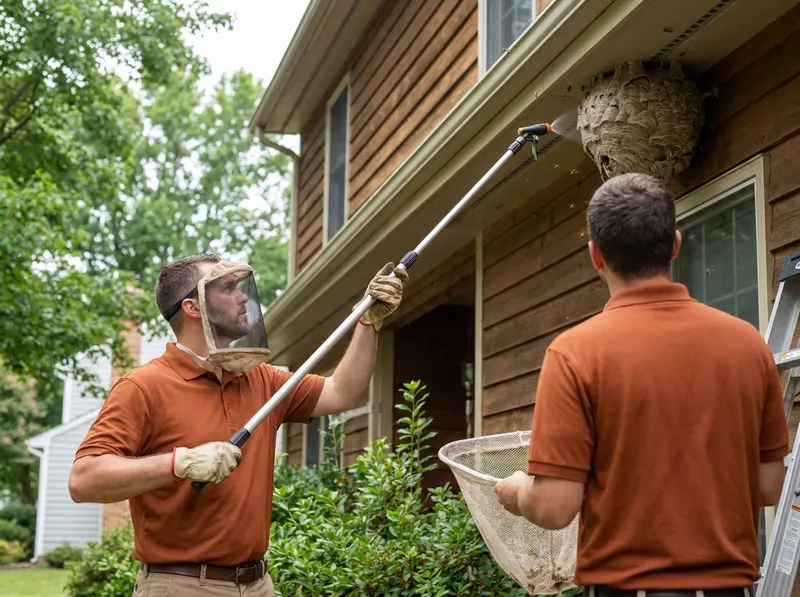
The decision that matters is whether you have an exposed nest or a hidden colony, because the work is completely different. An exposed paper wasp nest under a Prince Street porch ceiling or a bald-faced hornet ball in…
Call (804) 445-8072 →(804) 445-8072
Wasp, Hornet and Yellowjacket Nest Removal in Tappahannock, VA
Quick answer
  • Included: full exterior stinging-insect inspection (eaves, soffits, porch ceilings, shutters, gas meters, playsets, shrubs, ground holes), direct treatment of the located nest, removal of reachable paper nests, and sealing of the entry void where the structure allows.
  • Speed: most Tappahannock and Essex County stinging-insect calls are scheduled within 24 to 48 hours, and a single accessible nest is usually finished in one visit under an hour.
  • Cost: expect roughly $250 to $650 for nest removal in the Tappahannock area — $250 is the minimum charge for any stinging-insect visit, and the exact figure is confirmed on site before work starts.
  • What we handle: paper wasps under eaves and porch ceilings, bald-faced hornets in trees and shrubs, yellowjackets in ground burrows and wall voids, mud daubers on crawlspace joists and siding, and European hornets around lights and tree wounds.
  • Booking: call (804) 445-8072, describe where you see the insects entering, and you get an arrival window rather than an all-day wait — plus photos and written findings of what was treated.

The decision that matters is whether you have an exposed nest or a hidden colony, because the work is completely different. An exposed paper wasp nest under a Prince Street porch ceiling or a bald-faced hornet ball in a crape myrtle can be treated and taken down the same afternoon, and the site wiped so the pheromone scent does not draw a rebuild. A yellowjacket colony inside a soffit, brick weep hole, or hollow porch column is a void job: the insects are treated at the single entry point, foragers carry the material inward for a day or two, and the hole is sealed only after the traffic stops. Sealing a live colony too early is how yellowjackets end up chewing through drywall into a bedroom — so we time it, then close it.

Ground nests are their own category around here. Yellowjackets favor old vole tunnels and dry, undisturbed soil along field edges, which is why the calls from Millers Tavern, Center Cross, Champlain, and Dunnsville cluster in August and September, usually the day after someone mowed a fence line or pulled weeds at the base of a shed. Colonies at that point in the season are at peak population and defend a wide radius. If you were stung while mowing near Hoskins Creek or along a tree line off Mount Landing Road, mark the hole from a distance with a stake and stay away from it until it's treated — do not pour gasoline or boiling water down it.

Local building styles drive where the hidden nests turn up. Older wood-frame homes in the Tappahannock Historic District and along Water Lane have deep decorative trim, shutters, and porch ceilings that give paper wasps sheltered anchor points. Vinyl-soffit homes in Hobbs Hole and Essex Village hide yellowjackets behind J-channel and soffit seams, where the only visible sign is a steady stream of insects at one corner. Outbuildings and hangars along the Airport Road corridor near Tappahannock-Essex County Airport, plus dock boxes and shaded picnic areas near June Parker Marina, collect nests in metal framing and under lids. Golfers and grounds crews around Hobbs Hole Golf Course see the same August ground-nest pressure as farm fields.

Safety around pets, wells and gardens shapes the method. Nest-directed treatment uses a small, targeted amount of material placed at the nest or entry rather than a broadcast spray across the yard, keeps applications off vegetable beds and out of drip paths toward a well head, and keeps dogs and children off the immediate area for the short re-entry period stated on the label. Every visit ends with photos of the nest location and written findings, so you know exactly what was treated and which gap still needs closing. Where the nest sits above a second story, over a steep metal roof, or inside a chimney chase, we say so and price the access honestly instead of guessing from the driveway. If wasps keep returning to the same eave year after year, the fix is exclusion — screening gable vents, closing soffit seams, and capping open column tops — not another season of spraying.

What it costs

Single accessible nest (paper wasp or mud dauber, eave, porch ceiling, shutter)$250 – $325
Bald-faced hornet nest in a tree, shrub or fence line$275 – $450
Ground yellowjacket colony in lawn, field edge or under a shed$250 – $400
Yellowjackets or hornets in a wall void, soffit or porch column (treat, then seal)$375 – $650
Whole-house stinging-insect sweep, multiple nests on one structure$400 – $700
Elevated or difficult access (above second story, steep roof, chimney chase)quoted on site, from $450
Exclusion add-on: gable vent screening, soffit seam and column-top sealing$250–$500

Every job gets a firm, written price after a free on-site visit.

Common questions

How fast can someone get to a wasp nest in Tappahannock?
Most stinging-insect calls in Tappahannock and Essex County are scheduled within 24 to 48 hours, and nests over a door, on a walkway, or near a child's play area are treated as priority. You get an arrival window when you book at (804) 445-8072, not an open-ended all-day wait.
Do you remove the nest itself, or just kill the wasps in Tappahannock homes?
Reachable nests are physically removed after treatment on Tappahannock properties, because leftover paper and pheromone scent invites a new colony to the same eave. Nests inside a wall void, soffit, or ground burrow cannot be pulled out — those are treated at the entry point and then the opening is sealed once activity stops.
Why do yellowjackets keep showing up in my yard near Hoskins Creek every August?
Yellowjacket colonies around Tappahannock peak in late summer, when a nest started by one queen in spring can hold thousands of workers foraging aggressively for sugar and protein. Field edges, riverfront brush, and old rodent tunnels near Hoskins Creek and Mount Landing give them ideal nesting soil, so pressure builds every year from roughly late July through the first hard frost.
Is wasp treatment safe around my dog, well and vegetable garden in Essex County?
Nest-directed treatment at Tappahannock and Essex County homes places a small, targeted amount of material at the nest or entry hole rather than broadcasting it across the yard, and applications are kept off vegetable beds and away from well heads. You'll be told the label re-entry time before we leave so pets and kids stay clear of that one spot.
What does wasp and hornet nest removal cost in Tappahannock, and is there a minimum?
Nest removal in Tappahannock generally runs $250 to $650, with $250 as the minimum charge for a stinging-insect visit and inspection. Wall-void yellowjacket colonies and elevated nests sit at the upper end because they require a return trip to seal or extra access equipment, and the exact price is confirmed on site before any treatment begins.

Ready to get started?

Tell us about your wasp, hornet and yellowjacket nest removal job in Tappahannock and we'll send a clear, written quote — usually the same day.