Orlenta Pest Control ServiceOrlenta Pest Control Service

Ant and Carpenter Ant Control

Tell the two apart before you buy anything. Carpenter ants are large, usually black, and leave coarse frass — sawdust mixed with insect body parts — in small piles under window sills, at the base of porch posts, or on…
Call (804) 445-8072 →(804) 445-8072
Ant and Carpenter Ant Control in Tappahannock, VA
Quick answer
  • Included: species ID, interior and exterior inspection with a moisture check, nest and entry-point location, exclusion recommendations, targeted baiting or crack-and-crevice treatment, and written findings with photos.
  • Speed: most Tappahannock and Essex County homes get an on-site inspection within a few business days; bait-based ant jobs typically show sharp trail reduction in 3 to 14 days as workers carry it back to the queen.
  • Cost: most single-species ant treatments in Tappahannock run $250 to $325, with carpenter ant nest work commonly $325 to $500. A $250 minimum applies to any visit.
  • What we take: cash, check, and major credit cards; payment is due after the work is performed, not over the phone before anyone has seen the house.
  • Booking: call (804) 445-8072 to schedule a free on-site inspection with an exact written price before treatment begins.

Tell the two apart before you buy anything. Carpenter ants are large, usually black, and leave coarse frass — sawdust mixed with insect body parts — in small piles under window sills, at the base of porch posts, or on a crawlspace floor. Termites leave mud tubes and no frass. Older wood-frame houses in the Tappahannock Historic District along Prince Street and Water Lane, and homes on the Hoskins Creek waterfront, give carpenter ants what they need: shaded, slow-drying wood at the roof edge behind a clogged gutter, a deck band board that has been wet three seasons running, or a window trim joint that has lost its caulk. Carpenter ants do not eat wood — they excavate it to nest, which means the fix is finding and drying the wet wood, not spraying the ant you saw.

Nuisance ants are a different call. Odorous house ants trailing along a kitchen backsplash and pavement ants pushing sand out of driveway expansion joints move indoors when the ground outside gets too wet or too dry. Along the Airport Road corridor near Tappahannock-Essex County Airport, and in Millers Tavern, Center Cross and Champlain where lawns back onto soybean and hay field edges, field and pavement ant pressure comes from outside every year and does not care that you treated in April. For those, the durable answer is exterior baiting on the trail plus closing the specific gaps they are using — sill plate gaps, utility penetrations, threshold sweeps, siding-to-brick seams.

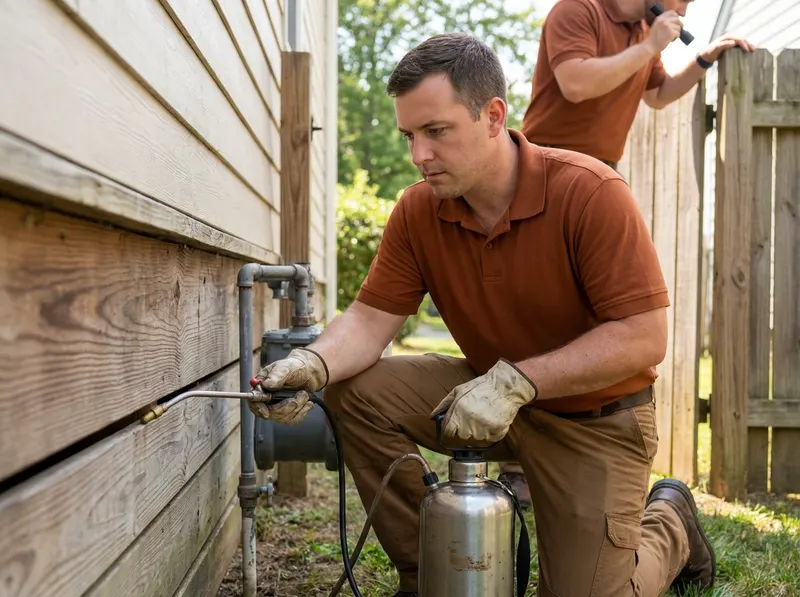
Here is the trade-off worth understanding. A contact spray kills the foragers you can see in minutes and feels satisfying, but with several ant species it fragments the colony into satellite nests and you get more trails in more rooms two weeks later. Bait is slower — you will still see ants for several days, which is the point, because they are hauling the active ingredient to the queen. We lead with bait and exclusion and treat pesticide as the last part of the job. That approach matters to the customers we see most in Dunnsville, Mount Landing, Essex Village and Hobbs Hole: pets in the yard, a well on the property, a vegetable garden by the back steps. Baits placed in cracks, wall voids and tamper-resistant stations keep product off surfaces where a dog or a tomato plant can reach it.

When exclusion is the bigger half of the invoice, we say so up front. Cutting back the limb that touches the roof, correcting a downspout that dumps against a foundation, or replacing three feet of rotted trim usually does more for a carpenter ant problem than any repeat spray schedule. If the inspection turns up hollowed structural wood, mud tubes, or a crawlspace moisture problem, that is a wood-destroying insect finding and we document it separately — the paperwork matters if the house is under contract. Every visit ends the same way: photos of what we found, where the nest and entry points were, what was applied, and what still needs sealing. Inspected, sealed, documented — the line holds.

What it costs

Single-species ant treatment, interior trails plus exterior perimeter and baiting$250 - $325
Carpenter ant inspection with nest location and targeted void treatment$325 - $500
Recurring exterior ant and perimeter service (per visit, quarterly)$250 - $300
Ant work including entry-point sealing and exclusion labor$450 - $900
Multi-nest, two-story, or multiple-structure carpenter ant jobs$600 - $1,200
Crawlspace-driven ant and moisture assessment with written findings$275 - $600

Every job gets a firm, written price after a free on-site visit.

Common questions

How do I know if I have carpenter ants or termites in my Tappahannock home?
Look for frass. Carpenter ants in Tappahannock push out coarse sawdust mixed with insect parts and leave clean, smooth galleries; subterranean termites build mud tubes along foundations and framing and leave gritty, soil-packed galleries. Swarmers help too — termite wings are equal length, carpenter ant front wings are longer than the back pair. Bring us the sample or a photo and we will identify it on the visit at no charge.
Why did the hardware-store ant spray fail at my house in Tappahannock?
Contact sprays kill the foragers on the counter, not the queen in the wall or under the slab, and with odorous house ants they can split the colony into several satellite nests. Ant control in Tappahannock works when the bait is matched to the species and placed on the active trail, and when the entry point they were using is sealed. That is why we identify the ant first and inspect for moisture before applying anything.
Is ant treatment safe around my dog, my well and my garden in Essex County?
Yes, when placement is controlled. For homes near Hoskins Creek, the June Parker Marina area and rural properties on private wells, we use baits in cracks, wall voids and tamper-resistant stations rather than broadcast spraying, keep product off garden beds and pet paths, and label-restrict applications near water. We tell you exactly what was used and where before we leave, in writing.
Do you cover the areas outside Tappahannock town limits?
Yes. We service Tappahannock plus Center Cross, Champlain, Dunnsville, Millers Tavern, Mount Landing and the Airport Road corridor, and we cross the Thomas J. Downing Bridge for work in the surrounding Middle Peninsula and Northern Neck. You get a scheduled arrival window, not a vague all-day promise.
How long until the ants are gone after treatment in Tappahannock?
Most Tappahannock ant jobs show a sharp drop in trailing within 3 to 14 days, because bait needs time to move through the colony to the queen. Carpenter ant nests tied to wet wood take longer to resolve permanently, since the moisture source and any damaged trim or framing has to be corrected. Seeing ants on day two is normal and expected; call (804) 445-8072 if activity has not dropped after two weeks.

Ready to get started?

Tell us about your ant and carpenter ant control job in Tappahannock and we'll send a clear, written quote — usually the same day.