The pattern repeats across older wood-frame houses here. A crawlspace within reach of the Rappahannock, Hoskins Creek or the low ground toward Mount Landing sits on bare soil that never fully dries, the vapor barrier…
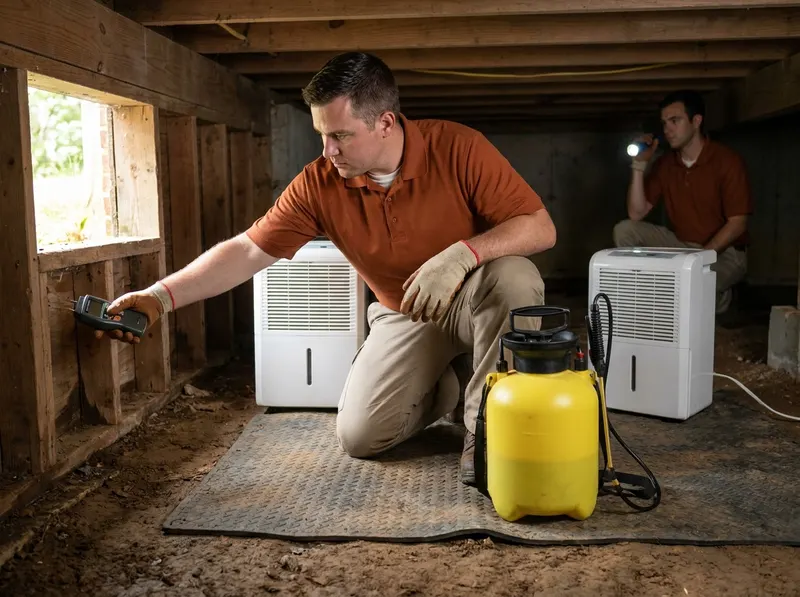
The pattern repeats across older wood-frame houses here. A crawlspace within reach of the Rappahannock, Hoskins Creek or the low ground toward Mount Landing sits on bare soil that never fully dries, the vapor barrier has been pushed aside by decades of plumbing work, and the fiberglass batts have sagged off the subfloor and gone dark with damp. Camel crickets colonize that. Homeowners in the Tappahannock Historic District along Prince Street and Water Lane usually meet them first in the living space — hopping up through a floor register, in a downstairs bath, or behind boxes in a closet over the crawl — and the crickets are only the symptom the house sent upstairs. Damp crawlspaces also feed wood decay fungus and make the structure more attractive to subterranean termites, which is why we take moisture readings on the joists and sills, not just a cricket count.
When this service is the right call: you see camel crickets more than once a season, you smell that musty crawl odor in the first-floor rooms, insulation is falling, or a home inspector or WDO report flagged high moisture. When a simple perimeter spray is the right call instead: a handful of crickets after a wet week in an otherwise dry, sealed crawlspace with an intact vapor barrier. Spraying a wet crawlspace is the treatment that fails — the population rebuilds from the soil within weeks, which is exactly what homeowners describe after hardware-store foggers and bait stations. The trade-off is honest: exclusion and moisture correction cost more on day one than a recurring spray, and they are the part that actually holds.
Work order, in the order we do it. First, entry and measurement — humidity, subfloor moisture, standing water, grade and drainage at the foundation. Second, exclusion: screening open foundation vents, sealing rim joist gaps and pipe penetrations, and fitting or replacing a crawlspace access door that no longer closes on its frame. Third, moisture: replacing or re-lapping the vapor barrier over exposed soil, clearing debris and wet cardboard, and pointing out downspouts and grading that dump water against the block. Only then does product go down, as targeted crack-and-crevice and perimeter application in the crawl and at ground-level entry points. If the space needs full encapsulation, interior drainage or a sump — larger construction than a pest visit — we say so in the written findings rather than treating around it.
Well and garden safety comes up on nearly every call in Dunnsville, Center Cross, Champlain and Millers Tavern, and it should. Low-volume, targeted applications in an enclosed crawlspace keep product away from the living area, the well head and raised beds, and we walk you through what was used and where before we leave. Every visit ends with photos and a written record of conditions, so you have a baseline for next spring, for a future buyer, or for the WDO report during a sale. Rural distance is not an excuse for a vague arrival window or a follow-up that never happens — houses off the Airport Road corridor, out at Essex Village, and around Hobbs Hole get the same scheduled return visit as anyone in town. Inspected, sealed, documented — the line holds. Call (804) 445-8072.
Every job gets a firm, written price after a free on-site visit.
Tell us about your crawl space moisture and camel cricket control job in Tappahannock and we'll send a clear, written quote — usually the same day.
 Orlenta Pest Control Service