Choose a liquid soil barrier when you want the treated zone in place the day the crew leaves. Trenching and rodding puts termiticide where the workers actually travel, and it does not depend on the colony finding a…
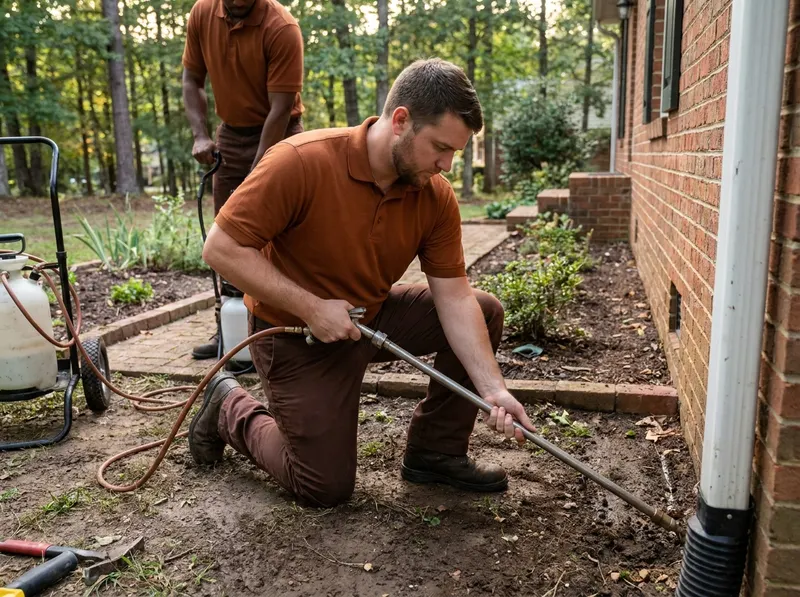
Choose a liquid soil barrier when you want the treated zone in place the day the crew leaves. Trenching and rodding puts termiticide where the workers actually travel, and it does not depend on the colony finding a station. That matters on the older wood-frame houses around Prince Street and Water Lane, where sills sit low, brick piers are close to grade, and a spring swarm on the inside of a window means tubes are already up in the framing. Bait station systems are the better fit on properties where trenching is impractical — heavy hardscape wrapping the house, a finished patio you don't want drilled, or a well head close enough that you'd rather keep liquid volume away from it. The trade-off is honest: baits work slower and require scheduled monitoring, while a soil barrier is faster to protect and needs periodic re-inspection to confirm it stayed intact.
Soil and water conditions in Essex County drive most of the decisions on-site. Near the Hoskins Creek waterfront and the low ground toward Mount Landing, the water table sits high and soils stay damp, so trench depth, drainage and downspout discharge get looked at before any product goes in the ground. Along the Airport Road corridor and in the newer slab houses near the Tappahannock-Essex County Airport, the work shifts to drilling — small holes through the slab perimeter, treated and patched — because there is no soil face to trench. Out toward Millers Tavern, Center Cross, Champlain and Dunnsville, field-edge and woodline properties usually add a second problem: stacked firewood, old stumps, buried form boards and mulch piled against siding, each one a bridge over any barrier. We flag wood-to-soil contact in the written findings, because a treated zone you step over with a mulch bed is a treated zone that doesn't hold.
Spot treatment fits a narrow, documented situation: one active area, one wall, one porch pier, no evidence elsewhere in the crawlspace. It costs less and it is legitimate when the inspection supports it. It is not a substitute for a full barrier on a house with tubes in two or more locations, and we will say so in writing rather than sell you the cheaper option twice. For homes selling in Tappahannock, the Virginia real-estate wood-destroying-insect report is the NPMA-33 form, and what it lists is evidence and damage — not a guarantee of a clean structure. If a report has already flagged your house, bring it to the inspection so the findings can be matched item by item.
Every visit ends the same way: photos of the mud tubes, piers, sill areas and moisture points; a written record of what was treated and where; and a plain explanation of what to watch for next spring, since swarms in this part of the Rappahannock valley typically show up on warm days from March into May. Pesticide is the last part of the job. Inspection, exclusion and moisture correction are the parts that keep the line holding. Inspected, sealed, documented.
Every job gets a firm, written price after a free on-site visit.
Tell us about your termite treatment and soil barrier job in Tappahannock and we'll send a clear, written quote — usually the same day.
 Orlenta Pest Control Service